
How to Price Menu Items: A Simple Formula for Restaurants
Pricing a menu is one of the most important decisions a restaurant owner makes — and one of the easiest to get wrong.
Price too low and you can be busy every night while still losing money. Price too high and customers quietly stop coming back. Most owners start by copying the restaurant down the street, but that ignores the one number that matters most: what each dish actually costs you to make.
The good news is that menu pricing doesn't need to be complicated. In this guide you'll learn a simple formula for pricing menu items, see worked examples, and get practical strategies to make your prices work harder in 2026.
Short on time? Use our free menu price calculator to turn your ingredient cost and target food cost into a suggested menu price in seconds.
The basic menu pricing formula
The most common way to price menu items is the food cost percentage method:
Menu price = Plate cost ÷ Target food cost percentage
- Plate cost is the total cost of every ingredient on the plate, including garnish, sauce and sides.
- Target food cost percentage is the share of the menu price you want to spend on ingredients — usually 25–35% for most restaurants.
Example
Your chicken sandwich costs $3.60 in ingredients, and you want a 30% food cost.
$3.60 ÷ 0.30 = $12.00
That's your starting price. From there you adjust for competition, perceived value and how the price looks on the menu (more on that below).
Step 1: Calculate your plate cost
Plate cost is where most pricing mistakes happen. Owners often guess, or only count the main protein.
To calculate it properly:
- Write a recipe card for the dish with exact portion sizes.
- Find the cost per unit of each ingredient from your supplier invoices (cost per ounce, gram, slice or piece).
- Account for yield. A 10 lb case of whole chicken doesn't give you 10 lb of usable meat. Trimming, bones, cooking loss and peeling all raise your real cost.
- Add everything — garnish, oil, sauces, bread, butter, sides and even packaging for takeout.
Plate cost example: burger
| Ingredient | Portion | Cost |
|---|---|---|
| Beef patties | 2 × 3 oz | $1.65 |
| Potato bun | 1 | $0.45 |
| American cheese | 2 slices | $0.30 |
| Pickles, onion, sauce | — | $0.25 |
| Fries | 5 oz | $0.40 |
| Paper and packaging | — | $0.20 |
| Total plate cost | $3.25 |
At a 30% target food cost, that burger should sell for about $10.85 — which you'd likely round to $11.
Want to skip the spreadsheet? Our free food cost calculator adds up ingredient costs for you and shows your food cost percentage instantly.
Step 2: Choose a target food cost percentage
Not every item should have the same food cost. Some categories naturally carry higher ingredient costs, while others are much cheaper to produce.
Typical target food cost ranges look like this:
| Menu category | Typical food cost % |
|---|---|
| Steaks and premium seafood | 35–45% |
| Burgers and sandwiches | 28–35% |
| Pasta and pizza | 20–28% |
| Salads and bowls | 25–32% |
| Fries and sides | 15–25% |
| Desserts | 20–30% |
| Coffee and espresso drinks | 15–25% |
| Soft drinks and iced tea | 5–15% |
| Cocktails | 18–24% |
| Beer (draft) | 20–28% |
| Wine by the glass | 25–35% |
The goal is a healthy overall food cost — many full-service restaurants aim for 28–32% across the whole menu. That means a premium steak with a 40% food cost is fine, as long as you balance it with high-margin items like pasta, sides, coffee and drinks.
Step 3: Check the price against your market
The formula gives you a starting point, not a final answer. Before you print or publish anything, compare it with:
- Direct competitors — similar restaurants in your area serving similar food.
- Your concept — a casual counter-service spot can't charge fine-dining prices, and a premium restaurant shouldn't look cheap.
- Perceived value — portion size, presentation, ingredient quality and the description on the menu all change what customers are willing to pay.
If your calculated price is far above the market, you have three options: reduce the portion, swap a costly ingredient, or accept a lower margin on that item and make it up elsewhere.
If it's far below the market, you may be leaving money on the table. Many owners underprice their signature dishes.
Step 4: Round prices the smart way
How a price looks matters almost as much as the number itself.
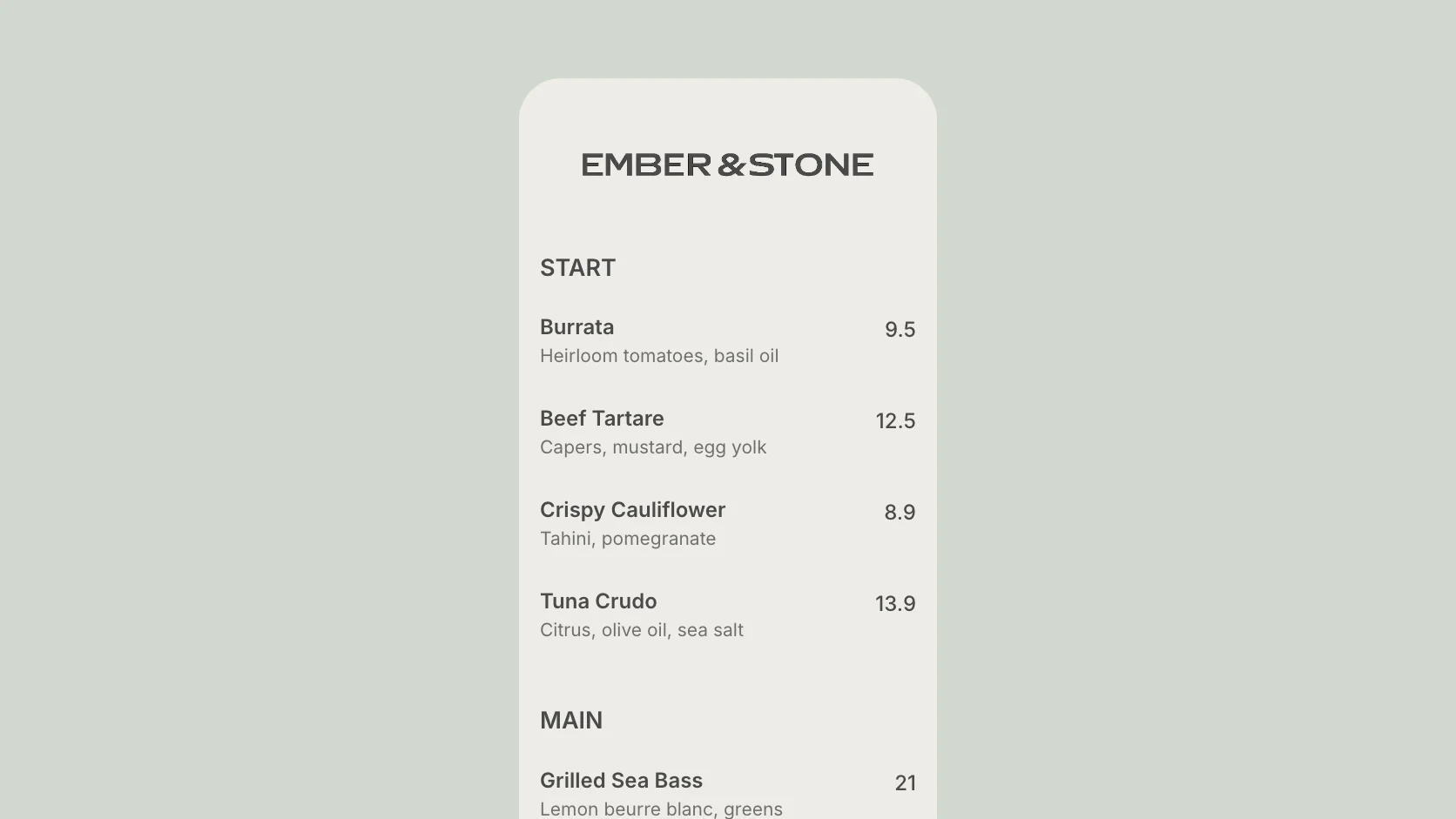
- Drop the dollar sign. Menus that show "14" instead of "$14.00" can feel less transactional and focus attention on the food.
- Avoid .99 in sit-down restaurants. Prices like $13.99 feel like discount retail. Whole numbers (14) or simple .50 steps (13.5) look cleaner.
- Use .95 or .99 for fast casual if that fits your brand — it signals value.
- Keep prices out of a single column. A right-aligned column of prices invites customers to scan for the cheapest item. Place the price right after the description instead.
Menu pricing strategies that increase profit
Once each item has a sensible base price, use these strategies to improve your overall margin.
Anchor with a premium item
Place one high-priced item — a tomahawk steak, a seafood tower or a tasting menu — near the top of a section. It makes everything around it look more reasonable.
Highlight your most profitable dishes
Not your most expensive dishes — your most profitable ones. Put them in a box, add a "house favorite" label or place them first in their section. This is the core idea behind menu engineering: promote items that are both popular and high-margin.
Bundle into combos and set menus
Combos (burger + fries + drink) and set menus (two or three courses) let you bundle low-cost items with high-cost ones and still feel like a deal to the customer.
Price add-ons separately
Extra protein, cheese, avocado, sauces, extra shots and premium sides are small decisions that add up quickly. Keep them clearly priced.
Offer two sizes
Small and large portions (or glass and bottle for wine) let customers choose — and many pick the larger option when the price gap is small.
Use descriptive language
"Slow-braised short rib with horseradish mash and red wine jus" sells for more than "Beef with potatoes". Specific, sensory descriptions raise perceived value.
How often should you update menu prices?
Ingredient costs don't stand still. Beef, eggs, coffee, cocoa and seafood have all seen big price swings in recent years.
Most restaurants should:
- Review food costs monthly for high-volume and high-cost items.
- Adjust prices at least once or twice a year, and immediately when a key ingredient jumps significantly.
- Make small, frequent changes rather than one large jump that customers notice.
This is where a printed menu becomes expensive. Every price change means reprinting. With a digital QR code menu, you can update prices in seconds and every customer sees the latest version.
Common menu pricing mistakes
- Guessing plate costs instead of using recipe cards and real invoice prices.
- Ignoring yield and waste, which can make your real food cost several points higher than expected.
- Copying competitors without knowing your own costs.
- Forgetting packaging and delivery fees on takeout items.
- Never updating prices, even when supplier costs rise.
- Pricing everything at the same percentage, instead of balancing high- and low-margin items.
A quick menu pricing example
Here's how the formula might work across a small café-restaurant menu:
| Dish | Plate cost | Target food cost | Calculated price | Menu price |
|---|---|---|---|---|
| Margherita pizza | $2.80 | 22% | $12.73 | 13 |
| Chicken Caesar salad | $3.90 | 30% | $13.00 | 13 |
| Smash burger + fries | $3.25 | 30% | $10.83 | 11 |
| Grilled salmon | $7.20 | 36% | $20.00 | 21 |
| Ribeye steak | $12.50 | 40% | $31.25 | 32 |
| Fries | $0.55 | 15% | $3.67 | 4.5 |
| Tiramisu | $1.40 | 25% | $5.60 | 7 |
| Latte | $0.75 | 18% | $4.17 | 4.5 |
Notice that some prices are rounded up based on perceived value (fries, tiramisu), while the steak sits at a higher food cost because customers have a clear price ceiling for it.
Put your prices on a menu customers can read
Once your prices are set, present them clearly. Group items into logical sections, keep descriptions short, and make sure the menu works on a phone — many customers will look at it online before they ever visit.
With mmmmenu, you can build a mobile-friendly menu from a restaurant menu template, publish it with a QR code, and update prices anytime without reprinting. If you're working on a specific concept, our menu ideas guides include suggested 2026 prices for BBQ, burgers, food trucks, bakeries and breakfast.
Frequently asked questions about menu pricing
What is the formula for pricing menu items?
The most common formula is menu price = plate cost ÷ target food cost percentage. For example, a dish that costs $4 to make with a 30% target food cost should be priced around $13.33, which you might round to $13 or $13.50.
What is a good food cost percentage for a restaurant?
Many restaurants aim for an overall food cost of 28–32%. Individual items can be higher or lower — steaks and seafood often run 35–45%, while pasta, pizza, fries and drinks are usually much lower.
How do I calculate the cost of a dish?
Write a recipe with exact portions, find the cost per unit for each ingredient from your invoices, adjust for trimming and cooking yield, and add everything up — including garnish, sauces, sides and packaging.
Should menu prices end in .99?
For casual and fast-food concepts, .99 or .95 endings can signal value. For full-service and upscale restaurants, whole numbers or simple .50 steps usually look cleaner and more confident.
How often should restaurants raise menu prices?
Review costs monthly and adjust prices at least once or twice a year — sooner if a key ingredient rises sharply. Small, regular increases are usually less noticeable to customers than one big jump.
Is it better to price by food cost or by competitors?
Use both. Start with your food cost so you know your minimum price, then check it against competitors and your concept to decide the final number.
How can I update menu prices without reprinting?
Use a digital menu with a QR code. You can change prices online at any time, and customers always see the latest version when they scan the code.