
How to Create a Restaurant Wine List (Pricing, Layout + Examples)
A good wine list can be one of the most profitable parts of a restaurant. A great one also makes guests feel confident, curious and well looked after.
But many wine lists do the opposite. They're too long, hard to read, organized in a way only a sommelier understands, or priced so that guests nervously pick the second-cheapest bottle. The result: lower wine sales and guests who stick to a single glass.
Whether you run a bistro, a steakhouse, a pizzeria or a wine bar, this guide will help you build a wine list that matches your food, suits your guests and makes money.
Step 1: Start with your food and your guests
Your wine list should feel like part of the restaurant, not an afterthought.
Ask yourself:
- What food do you serve? An Italian trattoria should lean on Italian wines. A steakhouse needs bold reds. A seafood restaurant needs crisp whites and rosé.
- Who are your guests? Casual diners want familiar grapes at fair prices. Wine lovers want discovery and interesting producers.
- What's your price point? Your average bottle price should feel in line with your food prices.
- Who will sell it? If you don't have a sommelier, your list needs to be easy for servers to explain.
Step 2: Decide how many wines to offer
Bigger isn't always better. A short, well-chosen list is easier to manage, cheaper to stock and easier for guests to navigate.
| Restaurant type | Suggested number of wines |
|---|---|
| Café, pizzeria or casual restaurant | 6–15 |
| Bistro or mid-range restaurant | 15–40 |
| Steakhouse or upscale restaurant | 40–100+ |
| Wine bar | 30–150+ |
For most restaurants, 20–40 wines is a sweet spot — enough variety for every taste and price, without overwhelming guests or tying up too much money in inventory.
Step 3: Cover the essential styles
A balanced wine list covers the main styles guests look for. A simple structure might be:
- Sparkling — Prosecco, Cava, Crémant, Champagne
- Light whites — Pinot Grigio, Sauvignon Blanc, Albariño, Vinho Verde
- Rich whites — Chardonnay, Viognier, white Burgundy
- Rosé — Provence-style dry rosé
- Light reds — Pinot Noir, Gamay (Beaujolais)
- Medium reds — Merlot, Chianti, Rioja, Côtes du Rhône
- Full-bodied reds — Cabernet Sauvignon, Malbec, Syrah/Shiraz, Zinfandel
- Dessert and fortified — Port, Sauternes, Moscato d'Asti
Make sure the most-requested grapes — Sauvignon Blanc, Pinot Grigio, Chardonnay, Pinot Noir, Malbec and Cabernet Sauvignon — are on the list. Then add a few less familiar wines for discovery.
Step 4: Choose how to organize your wine list
There are several ways to organize a wine list. Pick the one that suits your guests.
By style (recommended for most restaurants)
Sparkling → White → Rosé → Red → Dessert, with each section ordered from light to bold. This is the easiest structure for most guests.
By region
France → Italy → Spain → USA, and so on. Good for wine-focused restaurants and guests who know wine regions — and natural for restaurants focused on one country's cuisine.
By grape
All Chardonnays together, all Pinot Noirs together. Familiar for guests who order by grape.
By flavor profile (progressive list)
Sections like "Crisp & refreshing", "Rich & round", "Light & elegant", "Bold & spicy". Very approachable for casual guests.
Whatever you choose, order wines within each section from lightest to fullest, or from lowest to highest price.
Step 5: Offer wine by the glass
Wine by the glass is often where most of your wine sales happen. It lets guests try something new, pair a different wine with each course, or simply enjoy one glass.
- Offer 6–12 wines by the glass for most restaurants, covering sparkling, white, rosé and red.
- Include a house wine at an accessible price.
- Consider two pour sizes — a 5 oz glass and a 9 oz glass or a 500 ml carafe.
- Use a wine preservation system (like argon or Coravin) to keep opened bottles fresh and offer premium wines by the glass.
Step 6: Price your wine list
Wine markup
Restaurants typically mark wine up by 2–4 times the wholesale cost:
| Wholesale cost per bottle | Typical multiplier | Menu price |
|---|---|---|
| $10 | 3–4× | $34–$40 |
| $20 | 2.5–3× | $50–$60 |
| $40 | 2–2.5× | $80–$100 |
| $100 | 1.5–2× | $150–$200 |
Notice that the multiplier gets smaller as the wine gets more expensive. This "sliding scale" encourages guests to trade up — a $60 bottle that costs you $20 makes $40, while a $150 bottle that costs you $80 makes $70.
Wine by the glass pricing
A common rule: the price of one glass should cover most or all of the wholesale cost of the bottle.
A bottle with a wholesale cost of $12 might be sold at $12–$14 per 5 oz glass. With about five glasses per bottle, that gives a pour cost of around 20–25%.
Pour cost targets
Most restaurants aim for:
- Wine by the glass: 20–30% pour cost
- Wine by the bottle: 30–40% pour cost
Use our free menu price calculator to check your wine prices against your target pour cost.
Pricing tips
- Avoid making the house wine your only cheap bottle. Offer two or three good-value options.
- Have a strong "second-cheapest" wine — many guests pick it. Make sure it's a wine you're proud of, not a high-markup filler.
- Show prices clearly for glass, carafe and bottle.
- Don't use $ signs or .99 endings on an upscale wine list.
Step 7: Write useful wine descriptions
Most guests don't want technical tasting notes. A few words about style and food pairing help far more.
Instead of:
Sancerre, 2023 — Sauvignon Blanc, Loire Valley, France
Try:
Sancerre, Domaine X, 2023 — Crisp and citrusy with mineral notes. Perfect with oysters, goat cheese and grilled fish.
Keep descriptions to 5–15 words. If your list is long, add short descriptions only to by-the-glass wines and a few highlights.
What to include for each wine
- Producer and wine name
- Grape(s)
- Region and country
- Vintage (if relevant)
- Price by glass and/or bottle
- A short style note or pairing suggestion (optional)
Step 8: Make the wine list easy to read
- Use clear section headings.
- Align prices consistently, with glass and bottle prices in separate columns if you offer both.
- Keep fonts readable — wine lists are often read in low light.
- Highlight a few recommendations — "Sommelier's pick" or "Pairs with our steak".
- Put wines by the glass first — that's where most guests start.
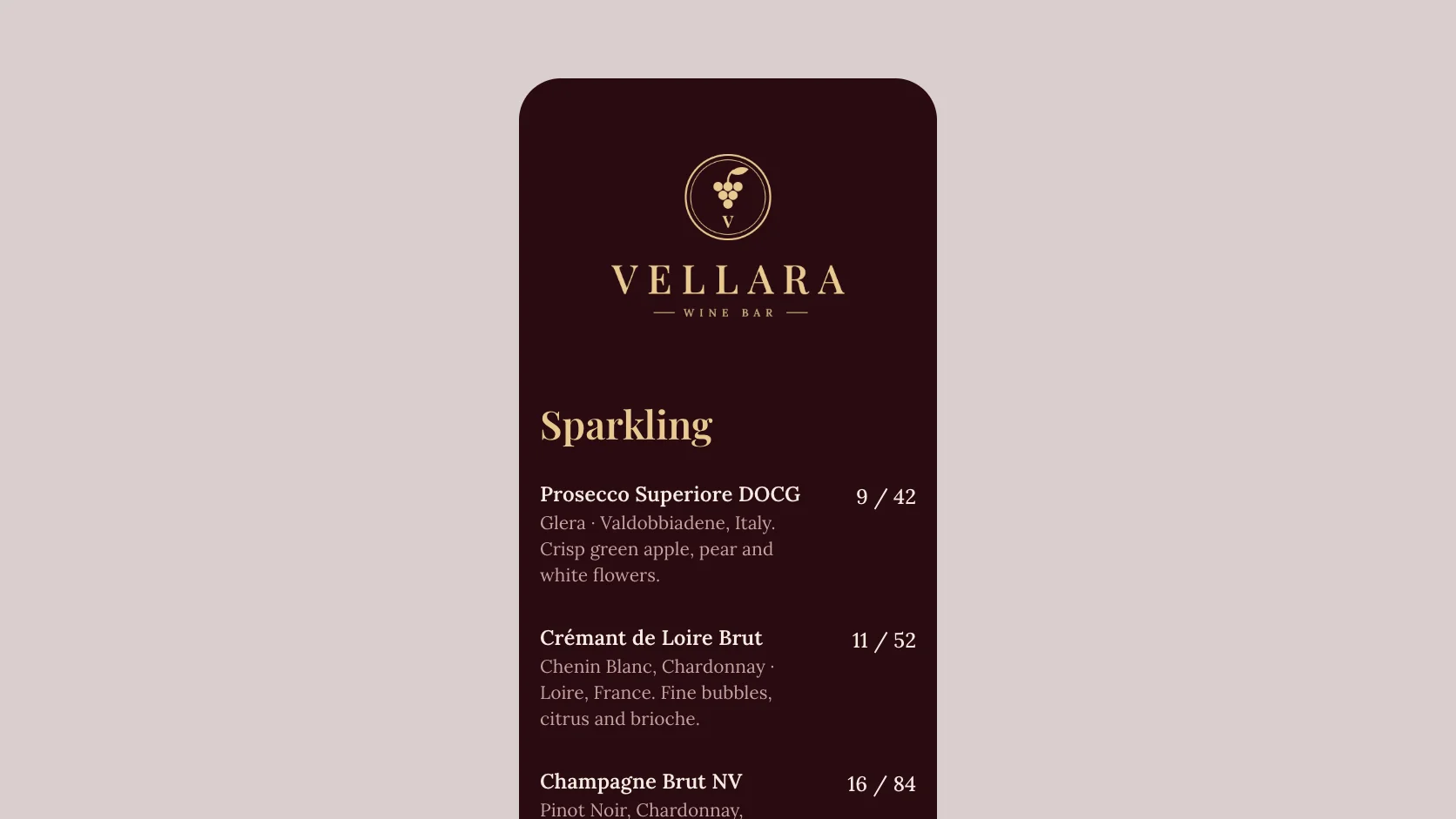
Our wine list template is designed for exactly this — clear sections, glass and bottle prices and a mobile-friendly layout with a QR code.
Step 9: Keep the wine list up to date
Nothing frustrates guests more than ordering a wine only to hear it's out of stock. Vintages change, suppliers run out, and prices rise.
- Review your list monthly for stock and pricing.
- Update vintages as they change.
- Rotate by-the-glass wines seasonally — lighter whites and rosés in summer, richer reds in winter.
- Track which wines sell and drop slow movers.
A printed wine list is expensive to keep updated. With a digital QR code menu, you can remove a sold-out wine or update a vintage in seconds.
Example restaurant wine list
By the Glass (5 oz / bottle)
Sparkling
Prosecco Superiore DOCG, Veneto, Italy — 11 / 42
White
Pinot Grigio, Alto Adige, Italy — 12 / 46
Sauvignon Blanc, Marlborough, New Zealand — 13 / 50
Chardonnay, Sonoma Coast, California — 15 / 58
Rosé
Côtes de Provence Rosé, France — 13 / 50
Red
Pinot Noir, Willamette Valley, Oregon — 15 / 58
Chianti Classico, Tuscany, Italy — 14 / 54
Malbec, Mendoza, Argentina — 13 / 50
Cabernet Sauvignon, Paso Robles, California — 16 / 62
By the Bottle
Sparkling
Crémant de Loire Brut, France — 54
Champagne Brut NV, France — 98
White
Albariño, Rías Baixas, Spain — 52
Sancerre, Loire Valley, France — 72
White Burgundy, France — 88
Red
Côtes du Rhône, France — 48
Rioja Reserva, Spain — 64
Barolo, Piedmont, Italy — 120
Napa Valley Cabernet Sauvignon — 145
Dessert
Moscato d'Asti, Italy — 10 glass
Tawny Port 10 Year, Portugal — 12 glass
Wine list ideas for different restaurants
- Italian restaurant: focus on Italian regions — Prosecco, Pinot Grigio, Vermentino, Chianti, Montepulciano, Barbera, Barolo. See our Italian restaurant menu ideas.
- Steakhouse: a deep red section — Cabernet, Malbec, Syrah, Bordeaux, Napa — with a few premium bottles. See our steakhouse menu ideas.
- Seafood restaurant: crisp whites, sparkling and rosé, with a couple of light reds. See our seafood menu ideas.
- Pizzeria or casual restaurant: 6–10 easy-drinking wines, mostly by the glass and carafe.
- Bar: a short list of reliable glasses alongside cocktails and beer. See our bar menu ideas.
Frequently asked questions about wine lists
How many wines should a restaurant wine list have?
Most restaurants do well with 20–40 wines. Casual restaurants and pizzerias may only need 6–15, while steakhouses and wine bars often offer far more.
How should a wine list be organized?
For most restaurants, organizing by style — sparkling, white, rosé, red, dessert — and ordering each section from light to bold is easiest for guests. Region-based and grape-based lists also work well for wine-focused restaurants.
How much do restaurants mark up wine?
Restaurants typically mark wine up 2–4 times the wholesale cost, with lower multipliers on expensive bottles. Wine by the glass is often priced so one glass covers the cost of the bottle.
How many wines should be offered by the glass?
Around 6–12 wines by the glass works for most restaurants, covering sparkling, white, rosé and red at a range of prices.
What should be included on a wine list?
Each wine should include the producer, wine name, grape, region and country, vintage (where relevant) and price by glass and/or bottle. Short tasting or pairing notes are helpful for by-the-glass wines.
How often should a wine list be updated?
Review your wine list at least monthly for stock, vintages and prices, and rotate by-the-glass wines seasonally. A digital wine list makes updates much easier.